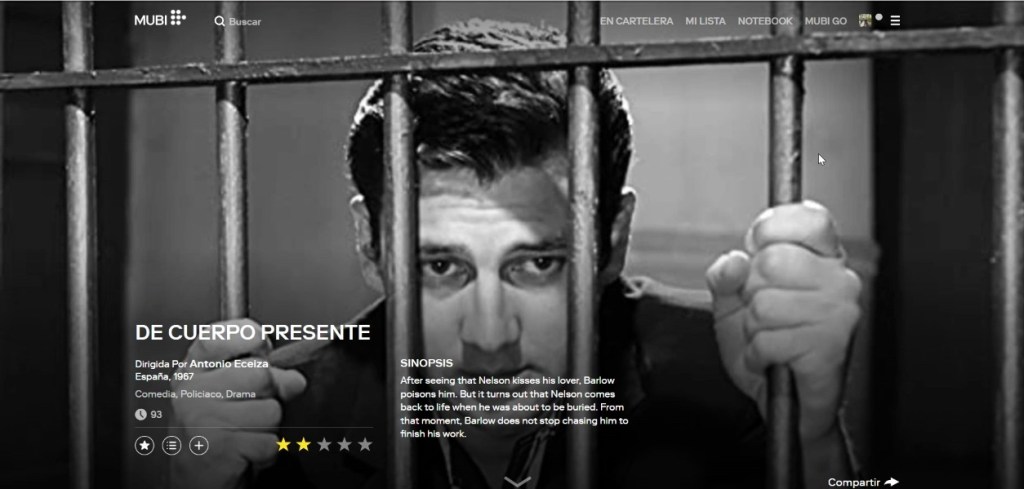
My grandmother used to say, and I sometimes say too, ‘He who dies for his pleasure, let him be buried standing up.’ But this dead man, Nelson, who is not entirely dead, will be buried in his pyjamas and has his soliloquy reserved as a protest against entrusting the viewer with his sorrow, the kiss to Mairin, the mistake, or was he not her husband? The courage, says the beautiful lady who spills Coca-Cola in the bathtub. If you enjoy theatre, you are in for a thanatologically cynical piece of cinematic black humour, and the occasional inspiration for later characters, such as Barlow, the boss with Al Capone-style tantrums, played by De Niro years later. And all because of that bloody kiss. This reviewer added “bloody” to tattoo this paragraph of the film with the irony of life in fiction. The best thing the real husband of the wife who received the fatal kiss can say is ‘let it go, that’s life’. Clarification: he is not her husband because Mairin later reproaches him for not wanting to marry her. Mairin whispers in the ear of the dead man, who was narrating his torment of being buried alive and suddenly falls silent, that she will wait for him in a while at 8 Avenida de la Paz. The transfer of the living corpse is interesting, but not that much. The jump from the coffin is comical, but only slightly, and in the blink of an eye he is at the house and is greeted by the beautiful Françoise Brion, or Enna, who calls him John and he insists on being called Nelson, confused and bewildered. The dialogues after eliminating the doctor there are like a caricature: ‘I no longer believe in love, I need easy women,’ Barlow tells Mairin, but Mairin is easy, only in favour of Nelson. The film is a string of such arbitrariness that make up Nelson’s day, which seems to become more and more surreal as it progresses. Suddenly, he has seized a weapon from the thugs, and Barlow lies on the ground. He must escape; perhaps he has killed him. Chaos erupts in a hospital where Enna and other Barlow henchmen have apparently taken him, but Nelson escapes. He continues to become less and less popular for escaping in a taxi, especially since he has no money to pay the driver and argues pointlessly in a scrapyard.
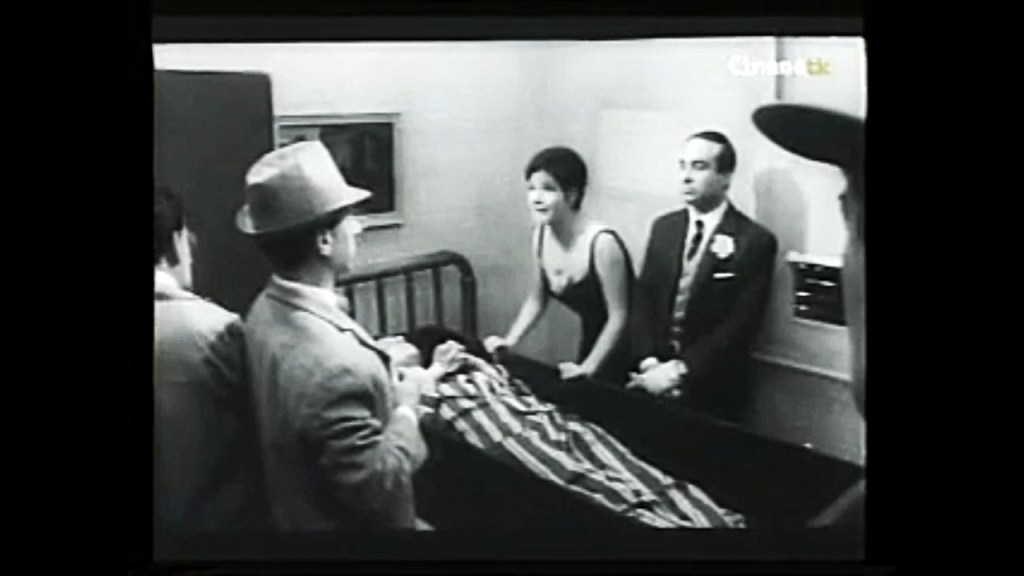
Then, once the driver, who has become one of the three Furies, leaves, Nelson walks to a multi-family building and almost asks for lodging. He knocks on the door and begs the woman who opens it to help him and apologises for being in his pyjamas. He hasn’t even finished taking a breath when he hears the door and it’s the husband, so the woman hides Nelson as if he were her lover while Nelson slips out of the apartment through the window despite being on a very high floor, and so on, running across the rooftops, he throws himself like Superman through the window of another apartment and falls onto the bed of a young woman and her sleeping mother. ‘What was that?’ asks the mother. ‘A man,’ she says. She complained as much as she could about the decisions she had made: she complained about the old man lying in the other bed and the decision to marry him young, as if he had held a gun to her head to make her do it. Nelson just wanted his suit and to get rid of those pyjamas. He now has a suit, but his joy is short-lived. In the next scene, he is on the sofa in another house with another woman who only talks to him about her husband named Henry and, of course, Nelson is wearing pyjamas. What a nightmare. The nightmare of the pyjama-clad satyr who prevents an obese woman, Evelyn, from committing suicide, telling her that life is worthless without love. From the street, the sound of sirens reaches that fourth or fifth floor, and they shout at the satyr that it is useless to keep running away and that they will throw tear gas at him because the house is under siege. ‘I won’t let them in,’ Evelyn shouts angrily. I won’t let them in, we will live in eternal love, she adds. When she escapes, she doesn’t, a TV programme with questions to win a trip to Venus was waiting for her and from there Thomas, a police commissioner who claims that they have invented Ron sin Cola. It was useless for Nelson to explain to her at the beginning of all the commotion just because he was drinking a Cuba Libre until Mairin arrived. And speaking of Mairin, Commissioner Tom made her sign a contract to advertise with the satyr and Ron Sin Cola, but Barlow and Mairion’s henchmen block her path in the desert and she flies away hanging from a helicopter to the room with a couple of journalists.In fact, with 25 minutes to go, the satyr has reached his limit and resigns. The journalists call him an idiot, good for nothing and a buffoon, but they lend him a tie and suit and he takes off his pyjamas for the umpteenth time. ‘Now you’re a nobody,’ both reporters shout at him, ‘but you’re free,’ they add. And women no longer find him handsome or attractive, and when he goes to see Evelyn, he gets bad news: she has committed suicide. The crazy sequences continue with him finding a friend with a hat who has to fight six other cowboys, who turn out to be him in a multiple mirror. He hasn’t found anything, Nelson finds Enna again and takes them to the waters or quicksand, and when they enter a kind of stable, the film never shows what is being narrated because Nelson throws himself with a rope and falls into a small pond with a photo of a smile. The end.
 Pantagruel´s liquor
Leave a comment