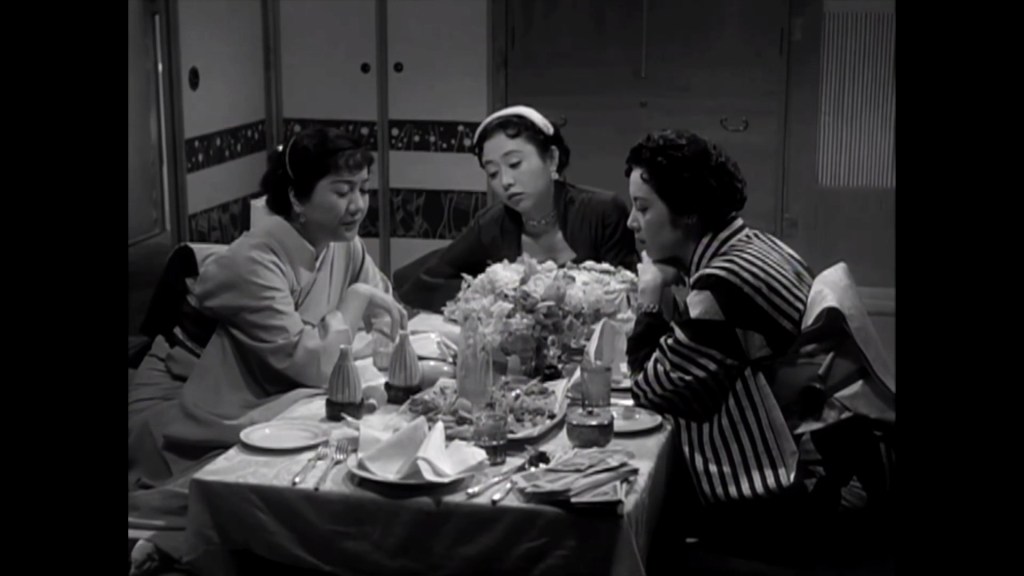
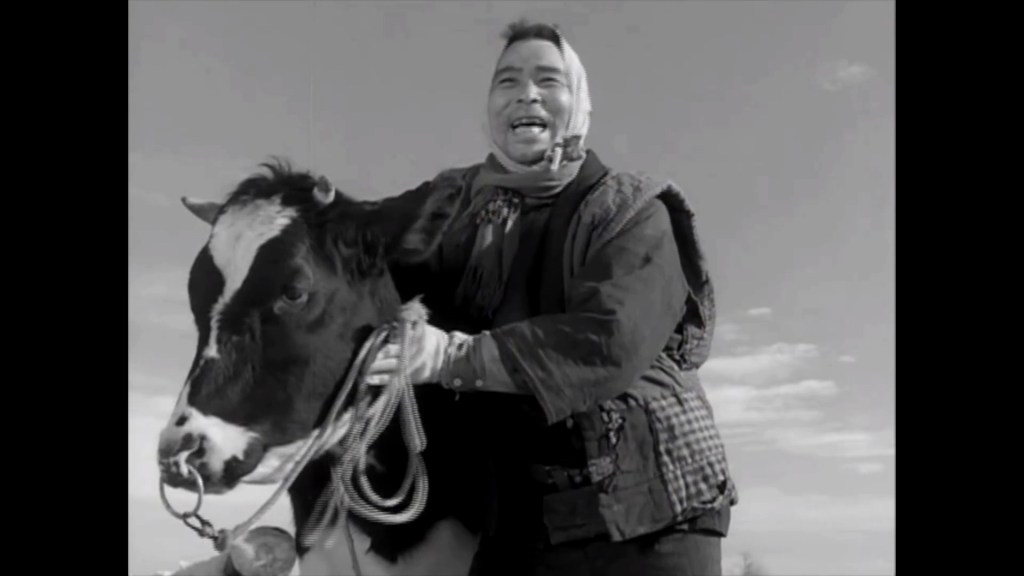
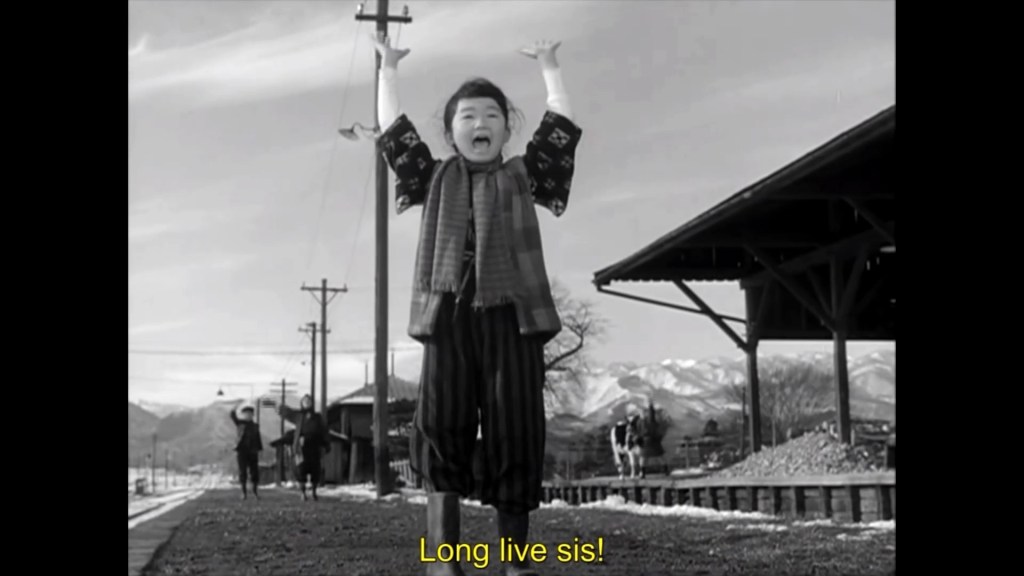
Although not literally or as an exact reproduction of historical paintings, this post-war masterpiece can be considered a raw tableau vivant of the geishas of the Shizumoto residence in Ginza, with a narrative that was clearly avant-garde for its time but, in any case, of superb psychological depth because it portrays each of them, including the secondary characters, such as the youngest, Satoko, as they are either contemplative or in the throes of their crises. The image of the old woman playing the shamisen in Yokufen, or the beautiful farewell given to Satoko by her father and sisters at the train station in her village – their faces contorted with grief – before she leaves for the capital, and specifically for the pandemonium of the seventh district of Ginza, where she enters as an apprentice in the geisha arts, are of enormous cultural value. In fact, two years after this film, Yoshimura would once again freeze Ginza in its flourishing ‘landscape’ of luxury and excess in Yoru no chô. Practically all of them—and who wouldn’t?—are hopeful of avoiding the same intangible opprobrium that is loneliness: one is obsessed with jazz because of her last love from two years ago and is a part-time public transport worker; another, called Terahu, feels a maternal love for Satoko, who has just arrived; Satoko, the 16-year-old apprentice, wants to make her parents proud but is sick with tonsillitis and hides it by making secret trips to the Tsukishima clinic in Tokyo. Kotoe, on the other hand, is a part-time singer who spends her youth on sake. She was unable to throw herself in front of a train (as we will see her crying to the landlady), She gets drunk and bitterly asks when she will be famous. Misao tries to take advantage of the young writer’s breakup with his boss and make him hers—without success—for marriage. Finally, Ikuyo, the landlady or owner of the Shizumoto House, has taken the young Eisaku Yanoguchi under her wing as her protégé, but not to be his lover, rather in the hope of companionship, especially when the fatuous Mr. Takanashi, her lover and benefactor, announces that he can no longer be with her due to his daughter’s demands.

Let’s say that it all began (but it wasn’t the beginning) when Takanashi’s son Kazuhiko approached the young writer Eisaku on the street and asked him for money from his pocket, since his father was the one who supported Ikuyo, so mathematically the money he had on him did not come from the landlady. It is no coincidence that Camus and Sartre are mentioned and that Eisaku is labelled an existentialist,
A taste of expresionism https://www.youtube.com/watch?v=UWW38A4Nc6I
even though he is not a Slav in the strict sense, because the existential crisis of the reasons for continuing clouded him to such an extent that he suddenly refused to let Ikuyo keep him. Wrapped in a swamp of tears, pain and sadness, Ikuyo discovers that one of her workers, Misao, is sleeping with the writer.
They fight, but the young man abandons both of them, and when they hear from him again, it is because his novel Parasite has won the literature prize. Both women, heartbroken, are contacted and imagine that it is to get back together with them, but at the meeting, he returns all the money they lent him, with interest. Cold, they watch the indifferent young man leave and sink into alcohol, when suddenly we learn that the Shizumoto House is on fire. Note the scene of Ikuyo walking like a zombie towards the burning building in a sequence of genuine 1920s and 1930s expressionism, while the crowd around her screams and carries water and moves away from the firefighters, watching the landlady enter the burning building as if nothing mattered to her anymore. Two women will blame themselves, Ikuyo but also Kotoe, which gives a strange burst of comedy that returns, incidentally making this work unclassifiable. Satoke explains at the police station that she longed with all her might to see her mother and father again and that with the iron and the fire, the landlady would allow her to go to her village, even handing over the cat in advance to the clinic where it was being treated for coughing fits and tonsillitis. In the bittersweet ending, Ikuyo urges her geisha to tidy up the house for when Satoko returns.
 Pantagruel´s liquor
Leave a comment