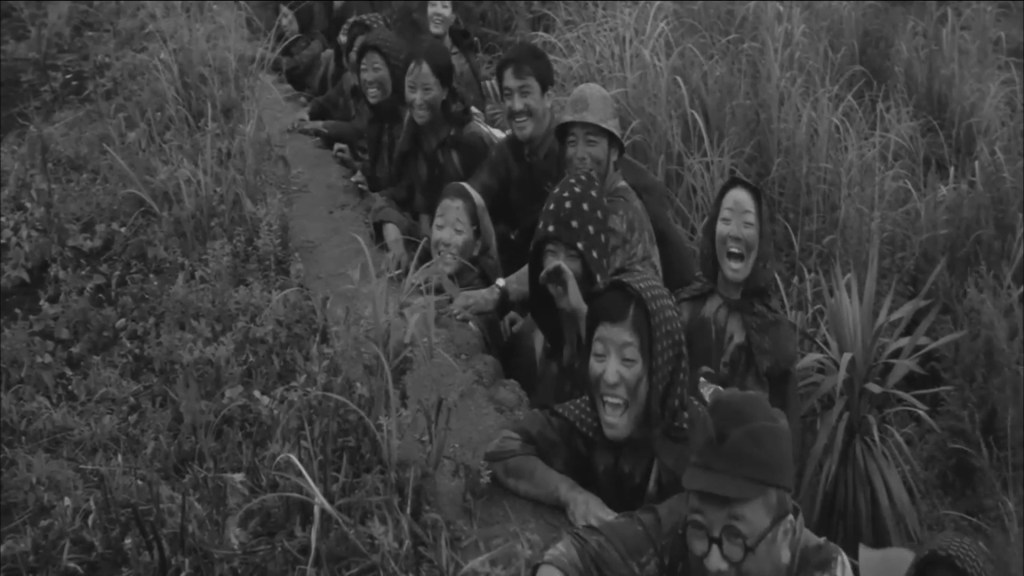
I refused to see it because Imai’s version of ‘Himeyuri no Tô’ (1953), which I enjoyed some time ago, left me breathless. Like Imai, this work honours the memory of the civilian victims and heroes of the people of Okinawa as part of Japan’s national identity, but more specifically the high school girls Kazuko was enrolled in; they hit the reverse lottery that fateful summer of 1945. How many Kazukos were beginning their teaching careers, making their angry brother and their mother, who was also a teacher, proud, only for the stupid war to reach the bay and turn them all into vulgar officers creating barricades and military lines? But if Imai was brutally blunt, Masuda achieves his harshness through soul-wrenching anguish rather than explicit violence in the heat of war. Masuda omits any scenes of the sinking of the Tsushima Maru, but he does not spare us the shock on the contorted faces of family and friends. Were the children on the Tsushima Maru saved? Were they saved?

The parents of the children used for war cry out at the director. The director dies of grief in front of them and remains silent. Hours later, he dies in private, committing suicide. It takes you by surprise as a viewer, at least it did me. Kazuko runs her fingers over the piano keys and starts playing instead of crying, with an expression of solace and dilettantism, but her brother Takeshi brings her back to reality and shatters her momentary escape: “If Mum helped evacuate the children, Mum is dead! She’s dead. There’s not a single child left, and Mum is dead.” October 1944, the 19th year of the Shōwa era, until the bombing begins. It had been a long time since I had seen a film as cruel as what happened to the Himeyuri squadron. As Matsunaga, Tomi-chan and all the others walk for miles without stopping in the rain, the hunger becomes unbearable and one says to the other, ‘Don’t say you’re hungry because we’re all trying to hold back.’

The officer lying on the ground sings to distract himself in the darkness and shoots himself, while another uses a grenade to end the nightmare. But the best parts are the moments of cruel humour, such as when it is the 27th day of the squeeze and the whole detachment bursts out laughing at the sight of the sergeant running after a chicken. The women, consumed with rage, want to recover the body of the teacher lying on the shore, and Nishizata-san tries in vain to stop them. Okokugako School for Girls. With only the two of them on the cliff, walking among the corpses of their classmates and friends, it was logical that they would choose the grenade up there facing the wide sea. The summary at the end is worse than terrible: ‘In the Battle of Okinawa, the number of students detained from the normal school for women was 1,503, including the students and teachers who accompanied them. Ninety-two teachers were laid to rest (died or were absent). Thus, the war took young victims from the schools.’

 Pantagruel´s liquor
Leave a comment