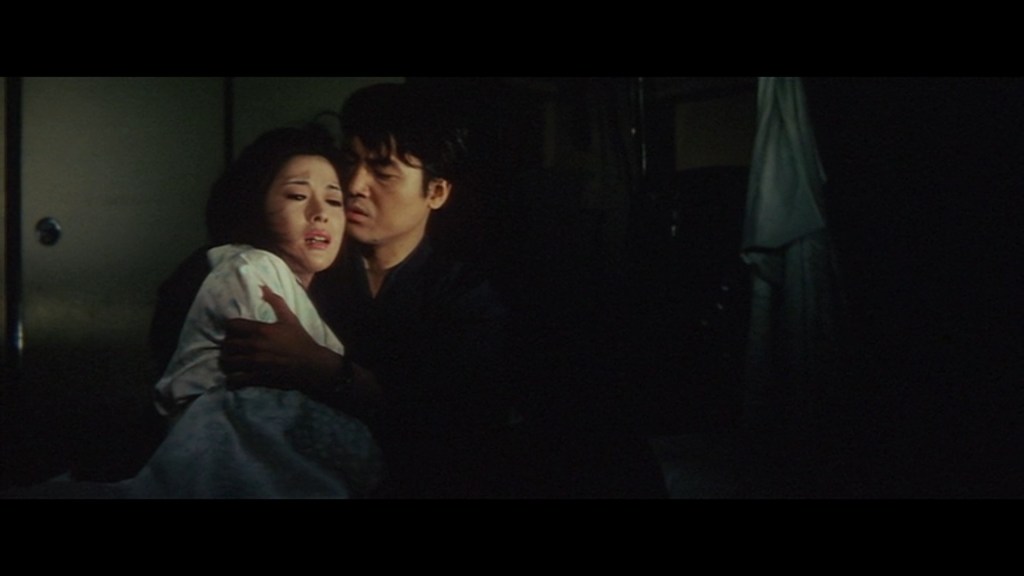
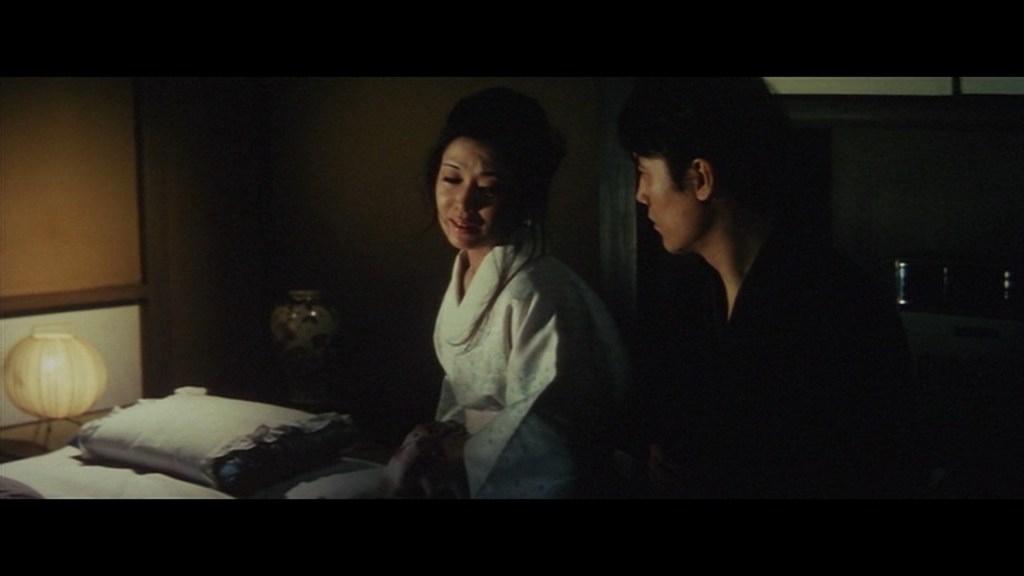
A remarkable adaptation of Senba zuru. Unfortunately, I made the mistake of reading ‘Utsukushisa to kanashimi to’ (Beauty and Sadness) first, which was written a decade later, and, to be honest, for those of us who enjoy Kawabata’s literature, Thousand Cranes does not achieve the maturity of style or the psychological depth of Beauty and Sadness. ‘Beauty and Sadness’ was adapted very poorly by Masahiro Shinoda because he modified Otoko’s psychological motivations, specifically his cunning revenge. Personally, I find ‘Beauty’ to be the better literary work, but cinematographically, this adaptation is far superior to Shinoda’s, even though Thousand Cranes is not as sublime in its filmmaking. Of course, Masumura is not perfect, starting with his narrator, who in this film is Kikuji, whereas in the original novel, the omniscient third-person narrator allows Kawabata to be introspective not only with Kikuji’s consciousness, but also with the guilt and resentment felt by his late father’s lovers, Ota and Chikako Kurimato, respectively. But following the same reading notes, Masumura’s clever choices are to be applauded, for example, conveying Kawabata’s ingenuity to the letter with a narrative thread that does not allow us to know – neither the reader, nor the viewer, nor Mrs. Ota—that Kikuji attended the tea ceremony because Chikako wanted to introduce him to the young Inamura as part of a miai (marriage meeting). In other words, Ota’s surprise is the viewer’s, and after having sex, he realises the twisted and dark way in which Chikako behaves. The film also conveys Ota’s sense of shame, especially when his daughter Fumiko tells him in the novel that he should have had another child with Mitani, but in this film the dialogue is even more direct, confronta yourself (0:23:48)You’re digging your own grave, mother. You already had a relationship with a married man (Mitani) and now you’re having a relationship with a man who is about to get married. Ayako’s heart-wrenching performance is exquisite. I’ve mentioned this before, not only because of her beauty but also because of her expressiveness. It is obvious that the masked matchmaker Chikako, behind her benevolence in seeing that Kikuji has settled down, hides her vengeful intentions against Ota well, and this has an effect on his suicide, in addition to the scolding from his daughter Fumiko.
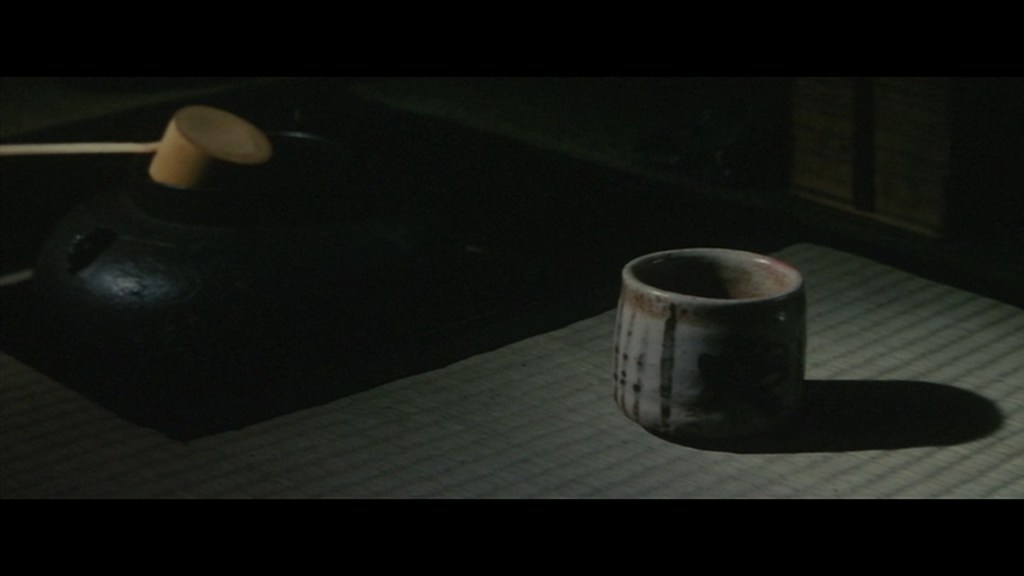
It is also noteworthy in this version that the director has not overlooked the fetishistic intentions or ghostly immortal objects added by Kawabata in ‘Thousand Cranes’, such as the black Oribe bowl splashed with white fern designs, which embodies a chain of possession laden with meaning: ‘It had passed from Ota to his wife, from his wife to Kikuji’s father, from Kikuji’s father to Chikako’, meaning that its history transcends its material value of four hundred years, for ‘The two men, Ota and Kikuji’s father, were dead, and here were the two women’. But it is also used in relation to Shino glaze Kikuji makes several comments about Shino glaze after Mrs Ota’s suicide, reflecting both its aesthetic value and the emotional weight it carries. He observes a delicate Shino piece used as a water jug in the tea ceremony, noting how well it goes with the flowers he sent for Ota’s funeral, and recalling that his mother sometimes used it for flowers, which explains why it was not sold. Later, while using a Shino bowl as a teacup, Kikuji discusses its quality with Fumiko, stating that, although he is no expert, he considers it a good Shino, while Fumiko insists that there are better pieces and that he should break it to avoid comparisons that make her sad. and that involves a lipstick stain on the rim of the bowl, which could be from Mrs. Ota, who used it daily, intensifying the emotional bond with her. These details, quite apart from the cranes as an element of purity and longevity, are observations that underscore how Shino becomes a symbol of memory, guilt, and emotional legacy after Ota’s death.
 Pantagruel´s liquor
Leave a comment