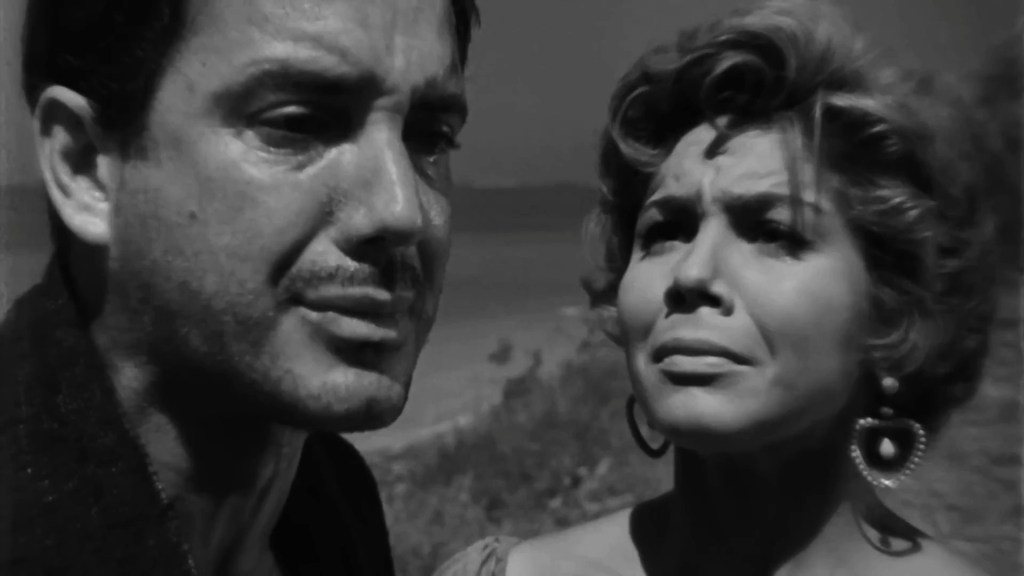
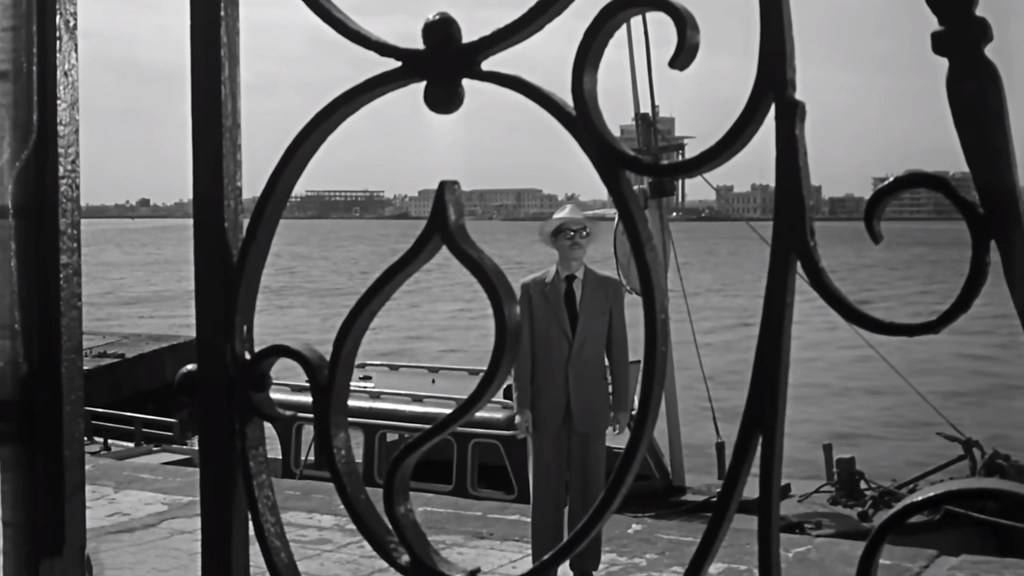
With keen intuition, faithful to his long-standing habit of incorporating modern historiographical icons of his time into his work, as he did with the Torre Latinoamericana (still unfinished) in El rebozo de Soledad, Gavaldón imagines that the old prison and fortress of San Juan de Ulúa in the port of Veracruz is the convent where Rosa Rivero, or Marga López, has been hiding for three years, the wife and victim of a love triangle between her husband and her twin brother-in-law. From the opening shot of the boat arriving with the investigator, Gavaldón not only captured the panoramic view of the islet ‘Tecpan Tlayácac’ in Nahuatl, a pre-Hispanic sanctuary dedicated to Yacatecuhtli as it functioned before San Juan de Ulúa was founded by the Spanish, but also, look in the background, the recently inaugurated Art Deco Jarocha building, I am referring to the misnamed Pemex building, the monument of the Bank of Mexico inaugurated by Miguel Alemán in 1952.
Once discovered, Rosa narrates her version in retrospect with an unmistakable Jarocha colour, as the events take the viewer to Isla de Lobos, which is actually where the lighthouse in front of Veracruz is located, that is, Isla de Sacrificios. I have no right whatsoever to judge whether or not it is a good adaptation because I have not read Julio Alejandro’s work, but I suspect that Gavaldón has taken literary licence to intersperse enough biases to make the plot realistically unscrupulous and disturbing. The twin brothers Rafael and Melchor live on the island with their respective wives. I repeat that Rosa is narrating the reason why she ended up crouching in the convent, deceiving the nuns as a single woman with no past. Rosa refers to the constant tension between her and María, Rafael’s wife, because at some point, María jokingly claims that Rosa’s husband did not kiss her, and this coincides with the day he apparently spent with his sister-in-law. In short, the womanising brother is Melchor and, according to his wife, he has always desired María, his brother’s wife.
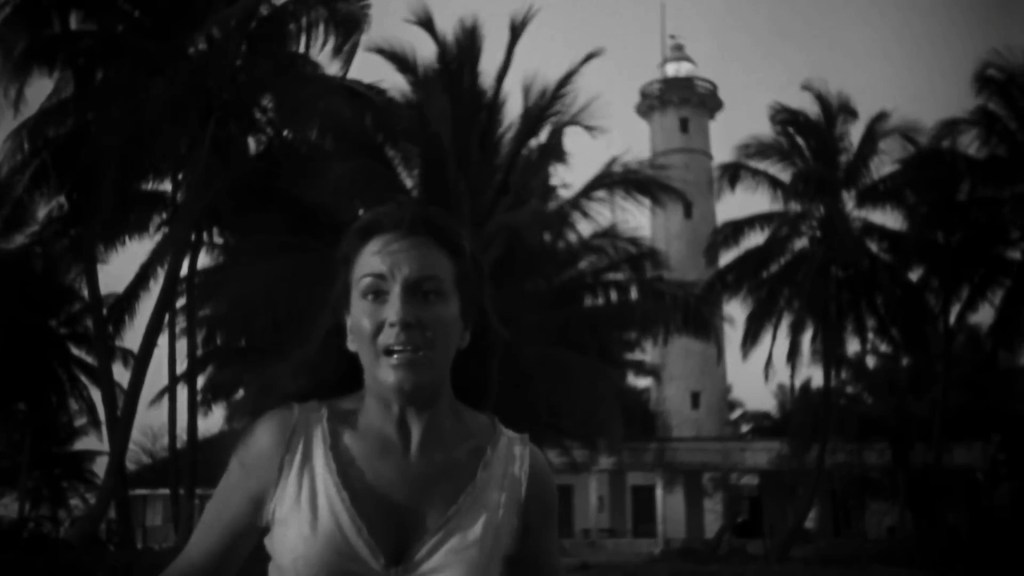
As things stand, the two women live off octopus fishing and other means, and they are jealous and aggressive towards each other over every man, as the two brothers are diametrically opposed, but so are the two women. while María lies on the bed listening to Gonzalo Curiel’s vinyl record ‘La quiero’ performed by Salvador García, Rosa turns the lighthouse on and off as well as cleaning; while María looks younger, Rosa is more demure. One day, a storm occurred that in Veracruz they call ‘Norte’ and happens annually between late autumn and winter.It is a cold front that destabilises the climate and causes strong gusts of wind – occasionally with rain – of over 90 and 100 km per hour. Unfortunately, a Norte caught the two brothers out at sea while they were fishing, and after days of bad weather, only one returned, and he was silent.
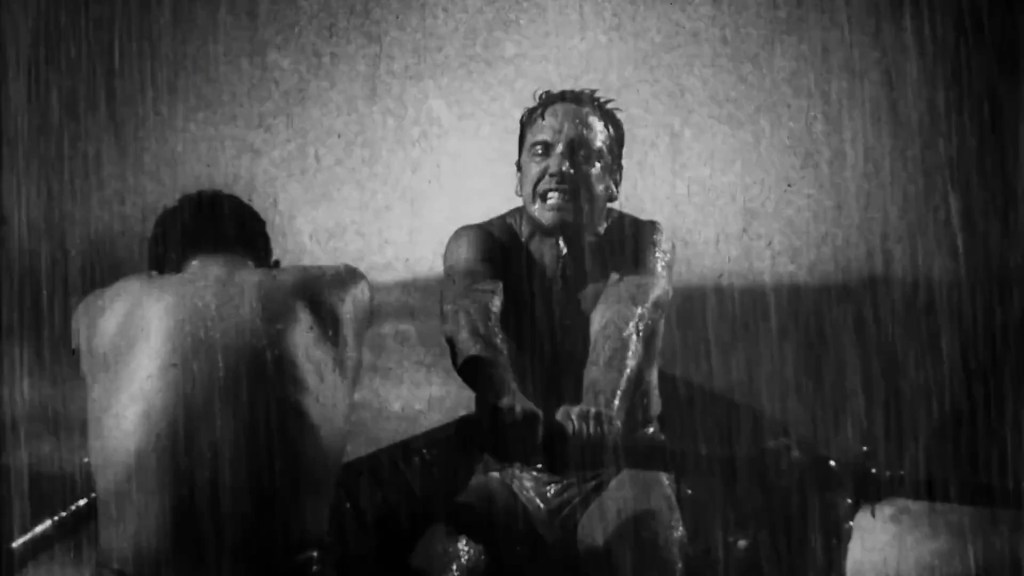

These were eternal seconds for the viewer, who did not know that it was Rafael who had returned. However, when the boat arrived and he was welcomed by the two women, the child and other villagers, what Freud called ‘slips of the tongue’ occurred, from accidentally calling a loved one by the name of another—a lover, an enemy, etc.—to other unconscious slips.When the castaway spoke, he said he was Rafael, but he had a Freudian slip and called his son Frijolito, a name always used by his brother Melchor. Rosa goes on to say that she had to swallow her husband’s charade, pretending to be his brother so that he could finally enjoy his sister-in-law by pretending to be her husband. We listen to her, but the film has shown no indication of this, and therefore up to this point the melodrama is more of a disturbing drama because it could be about a woman who has gone mad over the loss of her spouse. We still have a funeral among the fishermen there, and Rosa’s monologue is no less tortuous and suspicious, as I said, just like one of Bergman’s plots. The turning point, however, comes when, after a couple of days, Rafael, the real Rafael, emerges from the night and the sea, almost crying with joy at having managed to survive, and comes across a house where his brother Melchor has been pretending to be him in order to sleep with his wife, but his sister-in-law Rosa, the narrator, tries to hide everything so as not to hurt the child. Completely torn apart, she thought of asking María to leave with Rafael so that he would not suspect anything, but it was too late. The child, her own son, confessed to his father when they went fishing that his uncle had said he was him, but he had not fooled him. Rafael was filled with sadness and then rage, and it wasn’t long before he became sullen and defensive, until he tried to kill his own brother Melchor, who was lying drunk on the floor. Rosa stopped him and begged him not to kill him unless he killed her too. Rafael and María left with their son on the supply ship the next day, and Rosa made the mistake of believing that this way her husband would love her as she loved him. When he realised he was on an island alone with Rosa, he tried to escape in his boat until Rosa shot him from behind. Funny, locked up in what was a prison, as I said, in San Juan de Ulúa, who could she have hurt? That’s why the Mother Superior asked the detective to let her stay there.

 Pantagruel´s liquor
Leave a comment