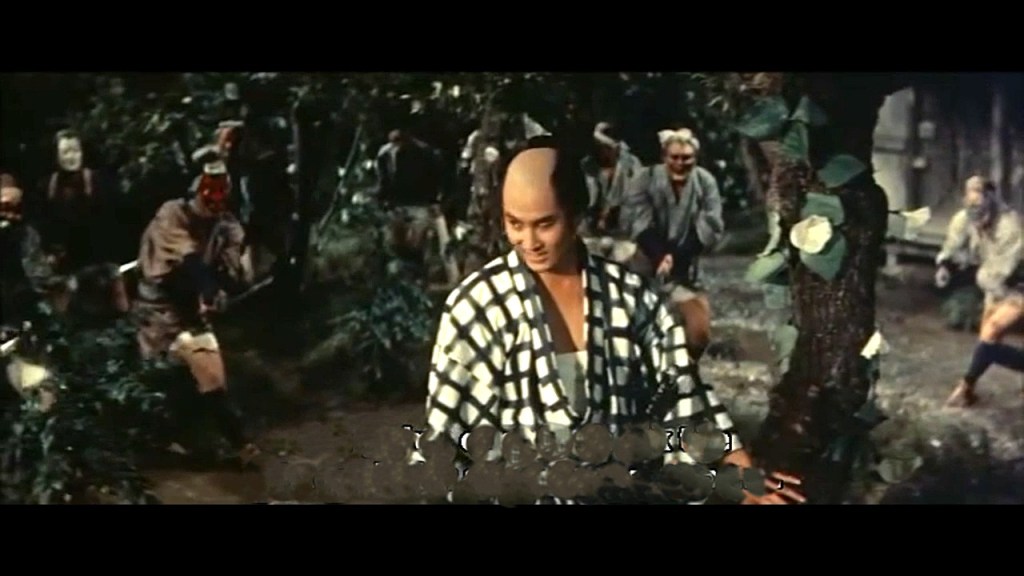
An extremely rare gem that celebrates the ninkyō eiga genre by focusing on the impulsive Ishimatsu, one of the lieutenants of the famous Jirocho Shimizu, a good-natured bandit and yakuza leader of the 19th century during the Meiji period. A plot that has become part of the collective imagination thanks to the passage of time and the spice that the legend, retold thousands of times, adds to all the popular rogues who rebel against the status quo. This is the case with Ishimatsu in this story, as a subordinate (kubon) of the gangster, just like his boss, Makino romanticises the criminal exploits in a comforting heroic vision of this one-eyed bandit, closer to the fictional simplification of operas than to the historical document it does not claim to represent. The story begins when Saru-ya Kansuke and Kyuroko have been defeated and dismissed from the port, but they have lost Butamatsu and his mother, who cries for her son without any of the other members of the clan offering condolences or even batting an eyelid. The head of the Miukeyama clan, Kamataro, harshly reprimands Wadajima, Eriji, Ishimatsu and even Jirocho for their coldness and lack of solidarity. Ishimatsu did everything he could to show how angry he was at being sent to the Sanuki Shrine 450 miles away.
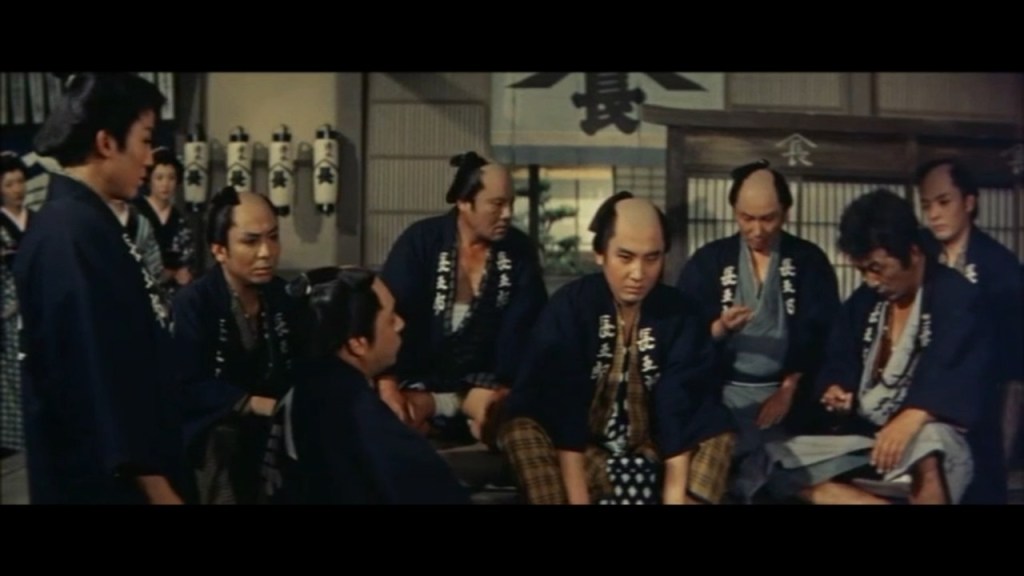
This was especially true given how long it would take him to travel back and forth over three long months and under his boss’s conditions: no alcohol and no women. The farewell scene is beautiful because it follows a Rokyoku-style stylistic pattern throughout the film, which is characterised by interspersing scenes with songs, and so we see Ishimatsu singing ‘For a sad one-eye bird of wander…’ (0:24:47). It is traditionally known that one of Ishi’s distinctive characteristics is that he does not have the sympathy or admiration of women – partly because of his naivety towards them, and that is why, in the middle of his journey, he turns green with jealousy when a fellow traveller tells him about his wife Ofuji and the way she looks at him. The journey is therefore a rite of passage symbolising the search for a woman and the exploration of self-knowledge. When he arrives in Sanuki, he does not know where to go to find a girl and, after asking for information, he abandons her to her fate.
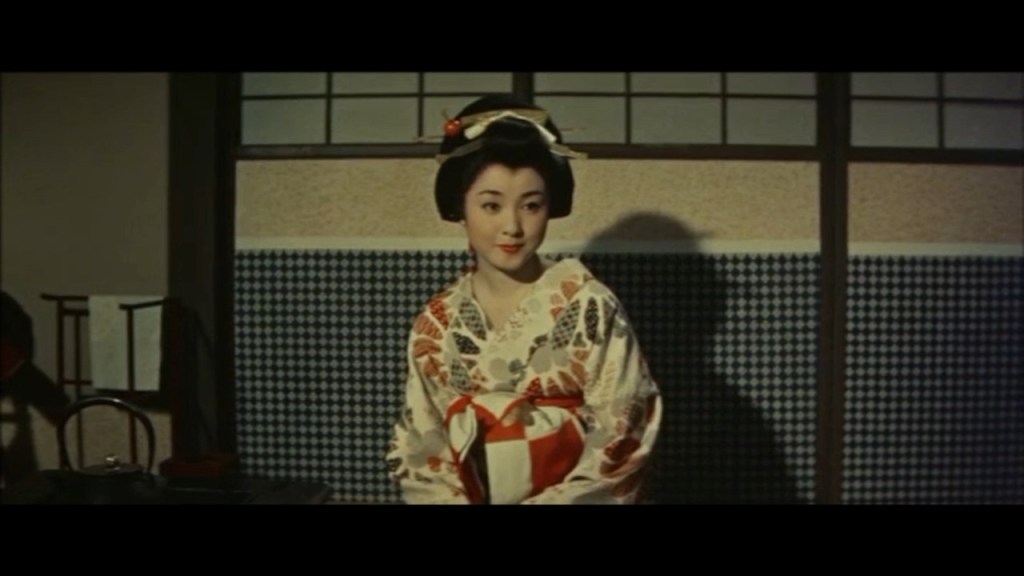
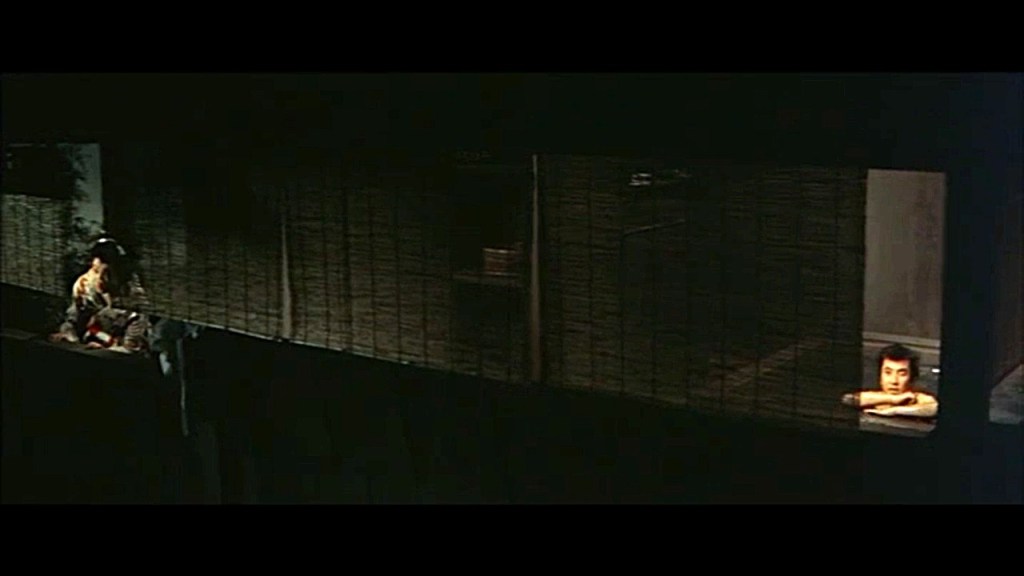
The first thing he does is ask for a recommendation and is told about the Kurouma brothel, where he meets Yugao. A sea of emotions overwhelms the boy, who has never had a woman, as he replays in his mind the words of his travelling companion Shichigoro and his delight at Ofuji, at the cloudy, moist eyes he saw in her. Ishi falls in love at first sight and immediately hands over the ryo that his companions and friends, but also Kamataro, Omino’s father, had given him to spend on her. The scene, shot from the front of the brothel at night, is exciting, as is the exchange of dialogue that continues after the yakuza leaves, the next morning before the departure of the ship is announced and it sets sail. Yugao gives him a letter that she hopes he will read when he returns to Shimizu with Kamataro and his daughter.
The old man, dressed as a peasant, has already collected another 20 ryo from him, which the immature Ishi finds strange and asks him why he is dressed like that. ‘I earned that money you lent me with sweat and tears over a long period of time.’ Then, the film takes on a marked theatrical rhythm in a sequence in the same place at Kamataro’s house. Ishi asks him to read Yugao’s letter and learns of her confession that her father, a yakuza, died without ever seeing her again and that when she met Ishi, it was the anniversary of her own mother’s death. like a flower shining in the moonlight, and in the morning, with the visitor’s departure, no one would recognise her from the night before, ‘only to fade away, like vanishing dreams’. Kamataro tries to kill him after getting angry that he did not make Yugao his wife, perhaps because he sees himself in a similar situation with Omino’s mother. The scene in which the Miyakoda brothers go to Shichigoro’s house to ask for the 2 ryo they lent him speaks of the deep morality that was once involved in fulfilling one’s commitments, even if it was money lost in gambling, as was especially common among yakuza members.

The brothers leave without Ishi or Shichigoro, but they will return to collect their money, and it is precisely the strength he has gained thanks to his romantic vision (the love he has just found) that arms him with courage, as if nothing could stop him, and announces to Shichigoro and his brave wife (who was the one who kicked them out of the house with poise and virility) that he will take care of eliminating the Miyakodas, who, incidentally, would also lose a finger if they did not repay the money they owed the yakuza. The final scene is classic Makino, who saves the tragic lyricism of the entire work for the dénouement. This time, Ishi is left open, badly wounded, with the song he wrote for Yugao in his mind. Will he live to see the next day to love her? Or will he?

 Pantagruel´s liquor
Leave a comment