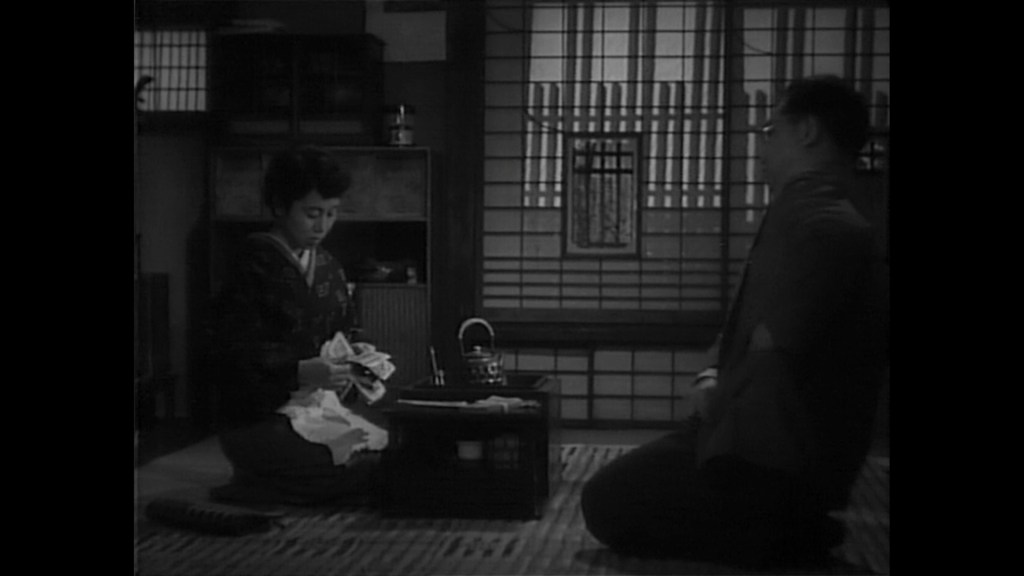
What a painful disappointment! Naruse masturbated Hayashi’s Bangiku; he turned Kin into a lioness of a moneylender, resentful to boot, and the original story into a painful melodrama of post-war survival featuring four bitter ex-geishas. Any adaptation should offer a different version. Adapting does not mean vulgar betrayal of the peculiarities of the characters in the original work. If I turned Elizabeth Bennet into an insecure and submissive woman, I wouldn’t dare call any version I came up with ‘Pride and Prejudice’ under any pretext. Adding the other three geishas to spice up the film with bursts of other stories is one thing. Stripping Okin (Kin in the original) of her obsession with beauty and her ritual with ice as if it were a face mask, and her hormone injections (she even gives herself one in the middle of a meeting with Tabe, excited), and omitting her rigorous diet is to corrupt Kin’s personality.
Compared to the story, this film is mediocre not only because it eradicates the psychological introspection of a 56-year-old woman (written, moreover, by another woman in a profession considered masculine) and her post-war feminine resilience (it was published in a magazine immediately after the lost war, in 1948), but also because of Naruse’s foolish redundancy in emphasising Japan’s social precariousness in an attempt at emotional blackmail. The director’s attempts border on a fallacy ad misericordiam, trying to make the viewer empathise through pity, which goes against the original work in which Kin carries her obsession with beauty and the care of her femininity and youth with haughtiness, which is why she despises one of her former lovers, Tabe, when he calls her and she gets emotional.
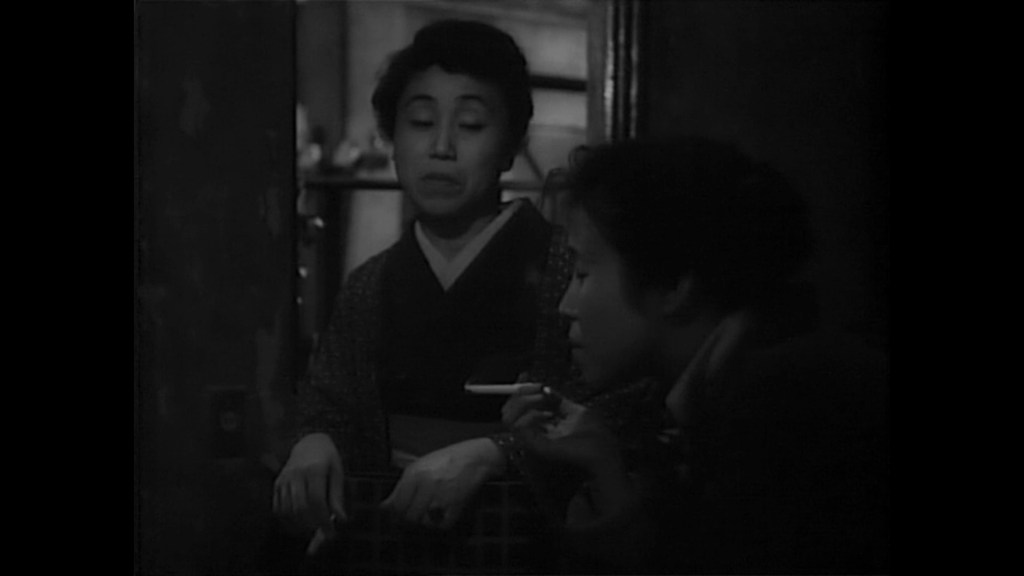
But this is in the original. Here, from the beginning to more than halfway through the film, Naruse repeats himself in paraphrases such as ‘debt’, ‘money’, “pay”, ‘I owe’, ‘lend me’, etc., and it all boils down to Kin collecting Tamae’s three months’ debt (money), the gossip among Kin about old Seki, or whether Tamae’s son has found a job and will pay (money again), and then, Tamae unable to pay, waiting for her son Kiyoshi, Kin collecting from Otomi who cannot pay (money again) and who is also being collected from by someone else. Sachiko confiding in her mother Otomi that she will marry an older man (money again), in short, narrative monotony. Forgive me if I offend, but there are authors such as Kaneto Shindó – see ‘Operation Negligee’ (1968) – who dealt with these issues of economic restoration and misery in a more fortunate and versatile way, even including bursts of comedy.
To top off this appalling melodrama about the economic hardships of a country just beginning to recover from war, Seki arrives at Okin’s house and asks her for 100,000 yen to leave Japan for Korea. She dismisses him angrily because she has already received Tabe’s letter about his visit and, in fact, Okin asked her mute maid to let him in when he arrived. When the reunion between the former soldier Tabe and the emotional Okin finally takes place in this film, 60 of the 90 minutes of the film have already passed, that is, two-thirds of the total. This means that Naruse devoted a third of the film to her, to Okin, the elderly woman who has retained her beauty and whose monologues in the meeting with Tabe, whom she has not seen since (with Naruse there are only a couple of lines of monologue), allow us to understand the crux of the author’s work: the simultaneous triumph and defeat of existence in the face of Japan’s moral and economic bankruptcy through memory, but also through beauty as a stark contrast to social and financial devastation.
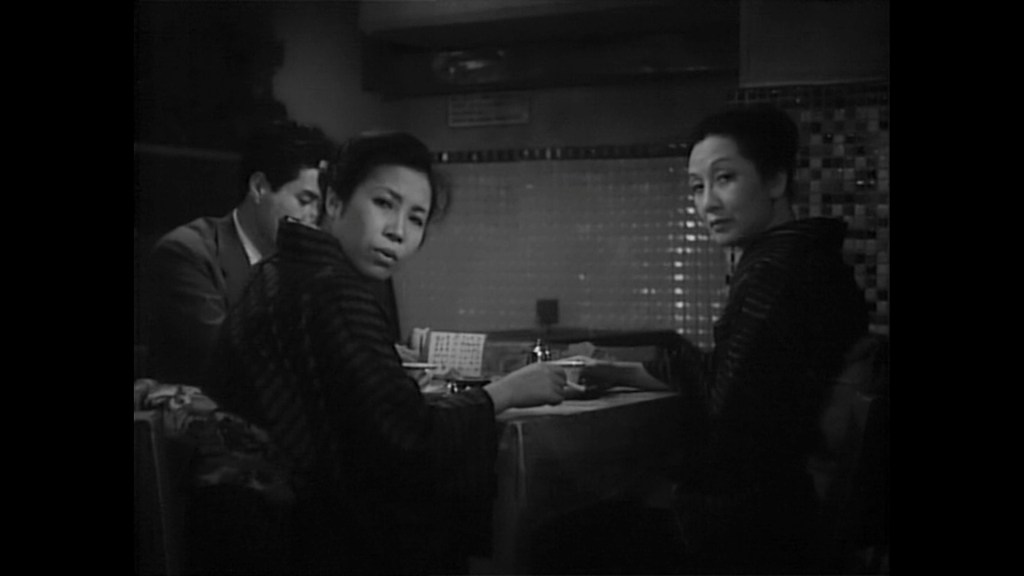
Unlike Naruse’s very poor work, Hayashi’s story reflects on how we construct or defend our identity in relation to the passage of time after a war: while Tabé has been transformed (degraded, he says in the story) by the experiences of war and everyday life, Kin (Okion for Naruse) has resisted change by clinging to rituals and memories, creating a living museum of herself that is simultaneously attractive and disturbing. This resistance to the natural flow of time (‘In the relentless flow of months and years… a woman from his past, unchanged, sat there, solid’) represents both a triumph and an existential defeat. In the story, she says, ‘I am so unhappy that I would do what a woman should not do: think about sex. That’s how I am.’ Naruse, on the other hand, adds the visit of Seki, who asks her for money to leave Japan before her date with Tabé. Regarding the date, Naruse again gets the ages wrong. The actor who plays Tabé is the same age as Okin, whereas in the original, although his age is not stated – as it is with Kin – we know that he was much younger than her when he was of enlistment age. Well, at least Naruse respected the burning of the photograph of the ex-lover with whom she once ran away when Tabé asks him to lend her 400,000 yen and then begins to look at him with pity. In the story, this happens from the moment she arrives at the rendezvous at Okin’s house. In this film, however, as I said, there is no fixation on beauty and rejection of ageing. In the original, Kin feels pity and even anger for a dishevelled and drunken man, while here Naruse, corrupting the idea, has him arrive at the rendezvous well dressed, and it is only when he asks Okin for a loan that she looks at him with ugliness.
 Pantagruel´s liquor
Leave a comment