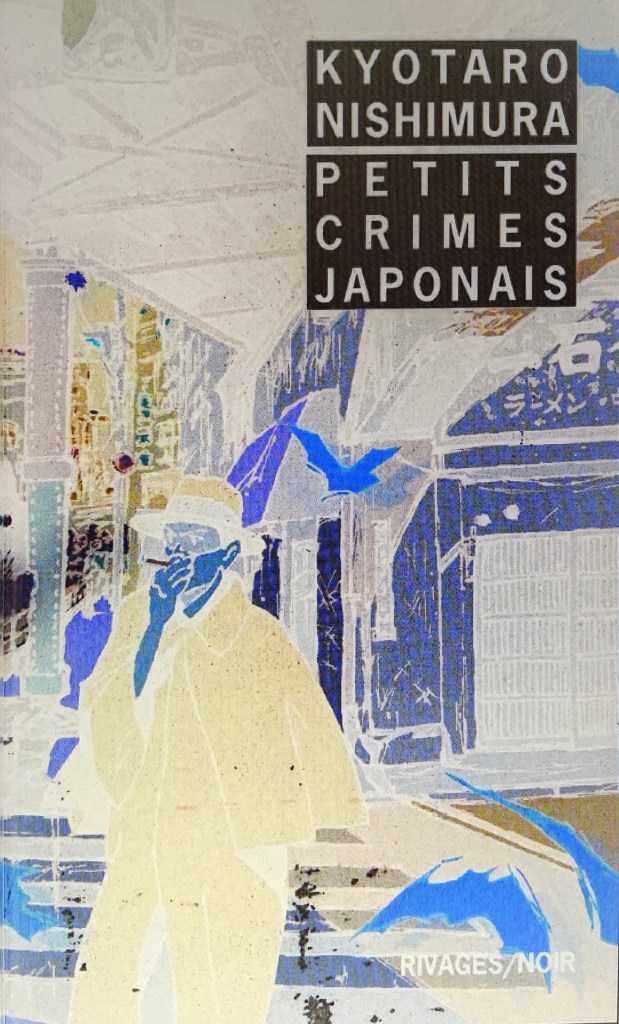
The floor is now open to the dark and little-known Kyotaro Nishimura, whose real name was Kihachiro Yajima, to toast Pantagruel’s drink. Unfortunately, only about 10 per cent of his more than 400 cult works in the noir and mystery genre have been translated. This book of short stories, Petit crimes japonais, translated from Japanese by Jean-Christian Bouvier and Jean-Paul Gratias, has only been translated from Japanese into German and French. I will focus on four curious stories that I translated myself from the French edition.
I. Metro à gogo
In the first story, ‘Metro à gogo’, we find ourselves in the life of Kotaro Fujiwara. At first glance, he is an office worker with an ordinary life, but this will change completely when he discovers his obsessive pathology. It all begins when this man, who is married to Kazuko (who, incidentally, is unfaithful to him) and is fond of building models, decides on a whim to break his routine by taking the metro in the opposite direction to his usual route. Fujiwara unwittingly experiences an extremely pleasant sensation when he observes a pickpocket stealing another passenger’s wallet. Is this the beginning of a pathology, a disorder yet to be identified? This event will never allow him to be who he was before, as it awakens a strange desire he has never felt before. From then on, his experience drives him to purchase daily subway passes that allow him to travel without restrictions throughout the Tokyo network, WITHOUT PAYING, in capital letters. Instead of going straight home after work, Fujiwara begins to prefer wandering around the subway for hours, furtively watching pickpockets in action. This new hobby he has just discovered fills his soul or his instincts; it is a pastime he finds addictive, and in fact, Fujiwara will sacrifice his family and professional life to devote himself to this strange pleasure. Although he never actively participates in the thefts, the superlative hedonism he feels when witnessing the thefts is unmatched, and he doesn’t even realise that he has become a consummate voyeur of crime. The problem is that everything gets complicated when his wife Kazuko notices his strange daily behaviour. Concerned about the changes in her husband, she begins to suspect that he has a mistress, but Fujiwara is hopelessly in love with his compulsive obsession with his secret life, watching pickpockets. Kazuko, convinced that her husband is cheating on her, plans with her lover Kozo Suzuki to murder Fujiwara to collect his life insurance. One night, Suzuki finally murders Fujiwara near a drainage canal by stabbing him with a dagger. Ironically, when he receives the fatal stab, Fujiwara smiles enigmatically, as if in that final moment he had found some kind of satisfaction or liberation. His body is discovered by a drunk passing by, who notices this strange smile on the corpse’s face. The police, led by Inspector Ueda, find one of the subway passes Fujiwara used for his obsessive wanderings in his pocket, along with several business cards bearing the name Kozo Suzuki, a clue that will eventually lead them to the killers.

Fujiwara embodies Freud’s theory of the conflict between the ‘pleasure principle’ and the ‘reality principle’. His ordinary, structured life represents the restrictions that society and civilisation impose on our most primitive desires, while his newfound obsession symbolises the ‘id’ or repressed impulses that seek satisfaction. All the guilt he feels for being a mere office worker, the guilt of the superego, ends up driving him to obsession.
The following story is somewhat more naive
II. The ‘good deeds’ of Agent Shibata
Police officer Shibata, a man in his forties who works in the troubled working-class neighbourhood of Jonan. In addition to his official duties, Shibata devotes himself to what he calls his ‘good deeds’, secret activities he carries out both during his shifts and on his days off. These mysterious ‘good deeds’ consist, paradoxically, of committing petty thefts in local shops and supermarkets. Accompanied by his young colleague Kosaka, aged twenty-five, Shibata patrols a neighbourhood that combines entertainment areas (cinemas, bars, pachinko parlours) with areas of human misery. During one of his rounds, Shibata decides to take action in a self-service store. While Kosaka talks to the manager, Shibata deliberately steals a small transistor radio worth six thousand yen, feeling a strange chill as he does so. It is the seventh time he has committed a similar theft. The story then reveals Shibata’s twisted plan. After carrying out these petty thefts, Shibata arrests innocent homeless people, falsely accusing them of the crimes he himself has committed. By fabricating evidence and obtaining confessions from these destitute individuals, Shibata builds an impressive record of solved cases that eventually leads to his promotion to sergeant. His system is meticulous: he chooses marginalised and vulnerable people, usually homeless, offers them food and drink, and then manipulates them into confessing to crimes they did not commit. In one of his cases, Shibata sets his sights on a homeless man known as ‘Iwakuni,’ whom he plans to frame for a recent robbery. He plants evidence (leaving one of his gloves at the crime scene) and constructs an alibi to incriminate him. However, his plan falls apart when he discovers that Iwakuni has died that same morning after a night of heavy drinking. The temporal inconsistency between Iwakuni’s death and the presence of his supposed glove at a later crime scene causes the inspectors to suspect Shibata, ultimately revealing his elaborate scheme of corruption.
This story thus demonstrates two things: (a) that the title of Nishimura’s compendium, ‘Small Japanese Crimes,’ is not gratuitous, and (b) that the author explores a contemporary reflection on the corruption of power and the perversion of justice. Shibata represents the paradox of the corrupt guardian: who watches the watchmen? Moore would ask: the one charged with protecting social norms becomes their main transgressor. From a psychological perspective, we can analyse Shibata through the neutralisation theory developed by Sykes and Matza, where criminals develop moral justifications for their immoral behaviour. Shibata has constructed an internal narrative where his criminal actions are justified by a ‘greater good’: the advancement of his career. The choice of marginalised victims reflects a process of dehumanisation where certain individuals are considered ‘disposable’ within the social system, facilitating their victimisation without generating guilt in the perpetrator. The story also addresses gradual moral corrosion: what begins as petty theft evolves into the systematic fabrication of evidence and the destruction of innocent lives. The final irony of Iwakuni’s fate underscores a principle of poetic justice: even the most meticulous plans to manipulate the truth eventually crumble under the weight of reality. This story invites us to reflect on how systems designed to protect us can become instruments of oppression when those in power lose their moral compass.
III. Love for one’s neighbour
The story ‘Love for One’s Neighbour’ begins with a visit by a young woman named Saiko Ono to the office of Dr. Miyoshi, a thirty-seven-year-old doctor. Contrary to expectations, Saiko is not seeking medical attention for herself, but help for her supposed neighbour, Mr. Kurita, a lonely and depressed elderly man who, according to her, has expressed suicidal thoughts. The young woman explains to the doctor that, concerned about the old man’s state of mind, she has challenged him to call a random phone number when he feels like dying, assuring him that someone will come to help him. Saiko explains in detail how she manipulated the situation so that the old man, who is superstitious by nature, would specifically call Dr Miyoshi’s number, based on his date of birth. She asks the doctor that, if he receives this call, to go and comfort the old man to show him that there is still goodness in the world. Dr Miyoshi, moved by the young woman’s apparent concern, agrees to help. However, a week goes by without receiving any calls. When his phone finally rings, it is a man who answers, identifying himself as Kurita and expressing his desire to die. The doctor, remembering his promise, goes to the old man’s home. Upon arriving, he finds an elderly man who offers him whisky while telling him about his troubles. During the conversation, the old man mentions that his daughter is pregnant and that he wants to leave her his entire inheritance. He asks the doctor to be a witness to his will. In the end, we learn that the real plan was that Saiko Ono and the old man, who is actually her father, are professional con artists and their modus operandi is based on pretending to be vulnerable people in order to manipulate compassionate doctors into signing as witnesses to false wills. Once they have obtained the signature, they poison their victims (not the old man, but real people who have been deceived) with prussic acid mixed with whisky, making it look like suicide backed up by medical testimony. The ending of the story shows that this is a common practice for them. With stratospheric cynicism, father and daughter discuss how they can justify their murders as an act of ‘charity’ or ‘love for one’s neighbour,’ arguing that they are freeing lonely elderly people from years of unnecessary suffering. The story ends with Saiko visiting another doctor, a paediatrician, to initiate the same pattern of manipulation, thus perpetuating their criminal cycle.
The corruption of the notion of empathy and the manipulation of altruistic values is clear here. From a philosophical perspective, it presents a macabre inversion of Kant’s categorical imperative: instead of treating others as ends in themselves, the con artists exploit both human kindness and the vulnerability of their victims for their own ends. It functions as a disheartening irony that emphasises the human capacity to rationalise heinous acts through seemingly noble excuses and justifications. The criminal duo represents functional sociopathy: individuals capable of perfectly understanding human emotions, not to connect with them, but to manipulate them. Their rhetoric of ‘doing a favour’ to the elderly by relieving them of suffering reflects a defence mechanism known as rationalisation, where morally acceptable explanations are constructed for morally reprehensible behaviour. The story also questions the inherent vulnerability of acts of kindness: should we protect ourselves against possible manipulation or take the risk of being deceived in order to preserve our ability to help? This ethical dilemma reflects the contemporary tension between prudent mistrust and compassionate openness to the suffering of others, suggesting that kindness, devoid of critical discernment, can become an unwitting accomplice to evil.
IV. The game of charity
‘The Game of Charity’ tells the story of Nishiwaki, a forty-two-year-old businessman who has amassed a considerable fortune selling air purifiers of dubious effectiveness through his company Air Squit. During a national charity gala, Nishiwaki ostentatiously donates fifty million yen, an extraordinarily generous sum compared to the usual donations, which did not exceed one hundred thousand yen. This gesture causes astonishment among the attendees, although rather than genuine admiration, it elicits contemptuous glances from representatives of traditional Japanese companies, who consider him an upstart. The narrative thread reveals that Nishiwaki’s motivation for this generous donation is purely calculated: he seeks to generate positive publicity for his company and improve his public image. His air purifiers, which sell for 26,000 yen each, have gained popularity thanks to rumours about their supposed effectiveness against pollution, rumours that Nishiwaki himself has fuelled by bribing private laboratories to obtain favourable results. As he himself acknowledges, he has ‘made a fortune selling wind’. After receiving applause and camera flashes for his donation, Nishiwaki is approached by an enigmatic white-haired old man who questions his understanding of charity. The old man, with a haughty but intriguing attitude, criticises Nishiwaki’s vulgar ostentation as ‘typical of the nouveau riche’ and explains that to ‘know how to give’ one must follow very precise rules. According to the old man, true charity is a ‘game’ that requires panache (elegance and style). He explains that originally the act of giving was a ‘ostentatious virtue of the nobility,’ where the compassion of the powerful towards the weak is nothing more than a reflection of their own power. The true art of charity, according to him, consists of ‘giving from above,’ turning the gift into ‘the refined image of a will to power.’ Intrigued by this philosophy, Nishiwaki asks if the old man practises this kind of charity, to which he replies affirmatively, adding that he does so ‘almost every day’ and that he ‘sublimates it through play.’ Therefore, when Nishiwaki asks for a concrete example of this form of charity, the old man offers to demonstrate it in person. The story culminates with both men leaving the gala together, with the old man promising to show Nishiwaki ‘the joys of true charity’.
Isn’t this beautiful, and perhaps ironically, the blatant motivation behind contemporary philanthropy? The psychology of social status is thus explored. The confrontation between Nishiwaki and the old man represents the clash between two conceptions of charity: a modern, instrumental and public image-oriented one, versus an aristocratic one based on social hierarchy and the pleasure derived from power. Nietzsche would have said in his classic ‘morality of masters’ and ‘will to power’ that even seemingly altruistic acts can be driven by motivations of domination and superiority. The old man articulates a Nietzschean vision where charity does not deny social hierarchy but reaffirms it, becoming a refined expression of power.
 Pantagruel´s liquor
Leave a comment