
Intelligent thriller. ANy’s sexual harassment at work and the harmful repercussions on her husband Tom would be nothing new, were it not for the delicious atmosphere of emotional suspense and opacity surrounding the marriage. Thanks to Any’s technological work, which revolves around the development of an almost invisible surveillance app that she uses in her own home and even while having sex with Tom, the central plot takes advantage of the same kind of contemporary panopticism that all users grant themselves when using social media, the cloud and AI bot chats.
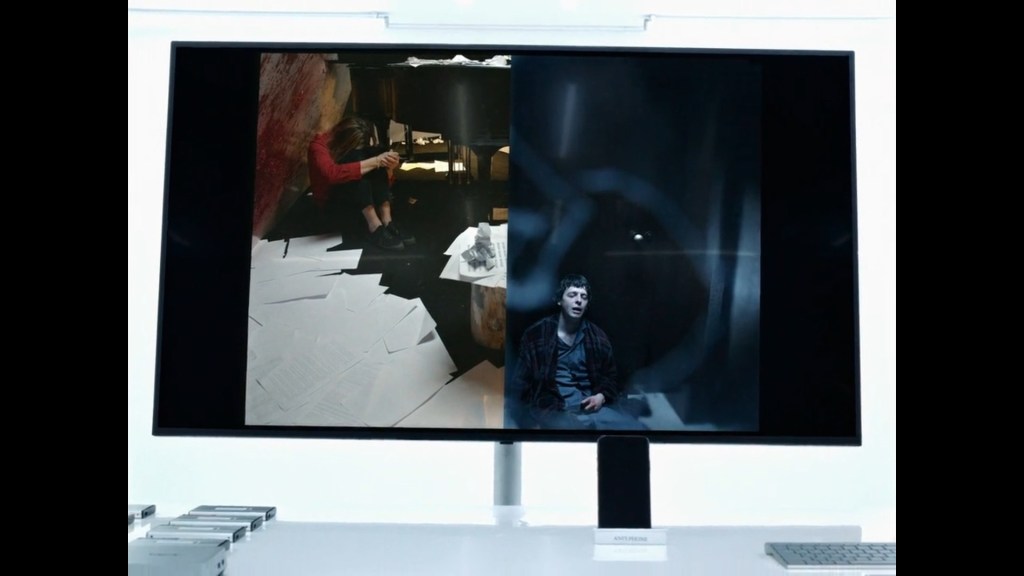
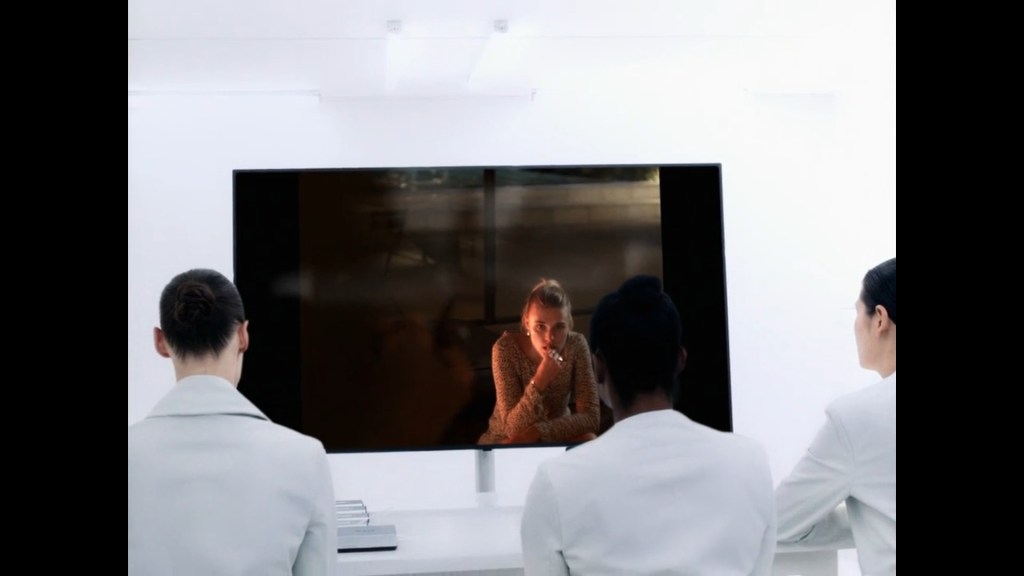
The meta-referentiality of the story proudly highlights its unhealthy ambiguity, as the viewer is unsure whose point of view they are observing. Simultaneously, the viewer observes three women in white in a kind of minimalist office, who are watching through cameras the same thing that Any is watching through her mobile phone camera, which is what her invention records (observes) in the home and whose recording can be turned off when Tom closes his eyes. More complexity is added to the equation when Tom, who is a writer, tells his wife that he will add ancient Greek choruses to the play he is writing, so there was – speaking for myself – the possibility that the three unknown women were a type of chorus that in classical Greece sometimes functioned with lyrical comments on the tragedy and interacted as in Aeschylus, and others as in The Suppliants, contextualising the plot.
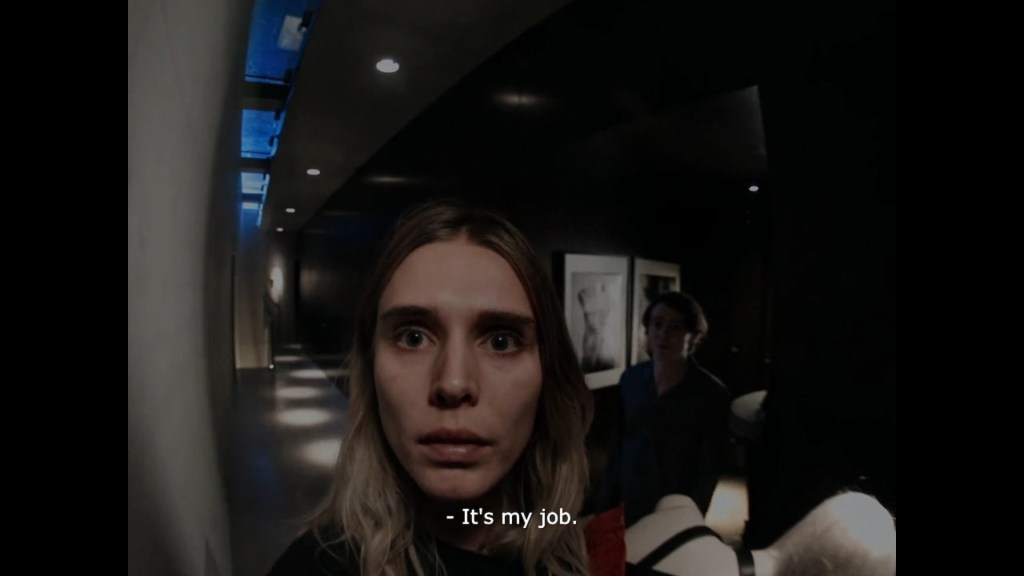
I am well aware that the husband’s jealousy and outburst of anger are the victim’s responsibility and could have been avoided because Any had already arrived disappointed by the fake massage from the company CEO Erik and his blackmail to promote and take into account her lamp invention until she went out to dinner with him. As the plot progresses and Tom naturally gets worse, especially after Any, using her invention, sent him a very short but illustrative video of her boss Erik massaging her and her resisting. Then, at certain moments, due to Any’s insistence on not reporting the harassment and even distancing herself from Tom, there is a lot of confusion: the husband could be a guinea pig through which the woman studies both her invention and her husband’s emotional elasticity – jealousy and domestic violence – adding compromising situations and filming their intensification. This is the film’s weak point, because in the end, Any does accept her boss’s invitation to dinner and it turns out that her husband was right, because Erik went too far, but by then Tom had already left the house, which was borrowed from a mutual friend. The viewer then learns that the three women are members of a kind of police corporation that analysed the images, and with this content analysis, Nay will proceed against the millionaire after gathering sufficient evidence. In today’s society, marked by hyperconnectivity and instant communication, this type of disorder manifests itself in intensified forms: Tom uses technology to spy on Ani (the ‘spy app’ he mentions), monitors her movements and distorts reality to confirm his suspicions.
This reflects a growing phenomenon of digital surveillance in intimate relationships that specialists describe as a modern form of abuse. Particularly alarming is how Tom rationalises his aggressive behaviour, distinguishing it from his ‘anger episodes’ and reframing it as something related to “domination” and ‘power,’ suggesting a distorted understanding of the dynamics of healthy relationships. This justification of abusive behaviour based on control impulses represents an increasingly recognised pattern in contemporary domestic violence cases, where the perpetrator develops elaborate narratives to normalise their behaviour.
 Pantagruel´s liquor
Leave a comment