
The influence of Godard—especially his five acts in Le livre d’image—on Mansour is undeniable, not only formally, in deconstructing the dramatisation and editing of violence to industrialise justified necropolitics, fear and intolerance, but also in the content of his denunciation, with both filmmakers coinciding in their falsification of terrorist narratives that promote colonial or, in any case, Western prejudices to normalise such violence in geopolitical conflicts. Western ones to normalise such violence in geopolitical conflicts. However, while Godard contrasted images of attacks with home videos made on mobile phones, Mansour adds current AI to the equation as a source of manipulation of official narratives (for example, the use of AI to generate decontextualised war iconography), which in itself is more disturbing due to its sophistication, versatility and opacity when it comes to settling the ‘truth’ in the media without falling into the simplistic dichotomy of ‘good’ and ‘bad’ in armed conflicts, thanks to the deeply numbed reception. It is no coincidence that Mansour begins the short film by highlighting Baudas. Baudas, formerly known as Baghdad or Mesopotamia, was the cradle of the first human civilisations, with glory and splendour, although the Western agenda setting today insists on tainting this topos with red, violence or religious intolerance through television news programmes, online mass media and social networks. This is no coincidence, because it speaks of the splendour that once existed in what is now considered the cradle of terrorism. When Godard recalls Cecil B. DeMille’s The Crusades (1935), he uses it to support the preservation of Eastern stereotypes and sugarcoat the eradication of customs and conquest (despite Saladin appearing quite noble).
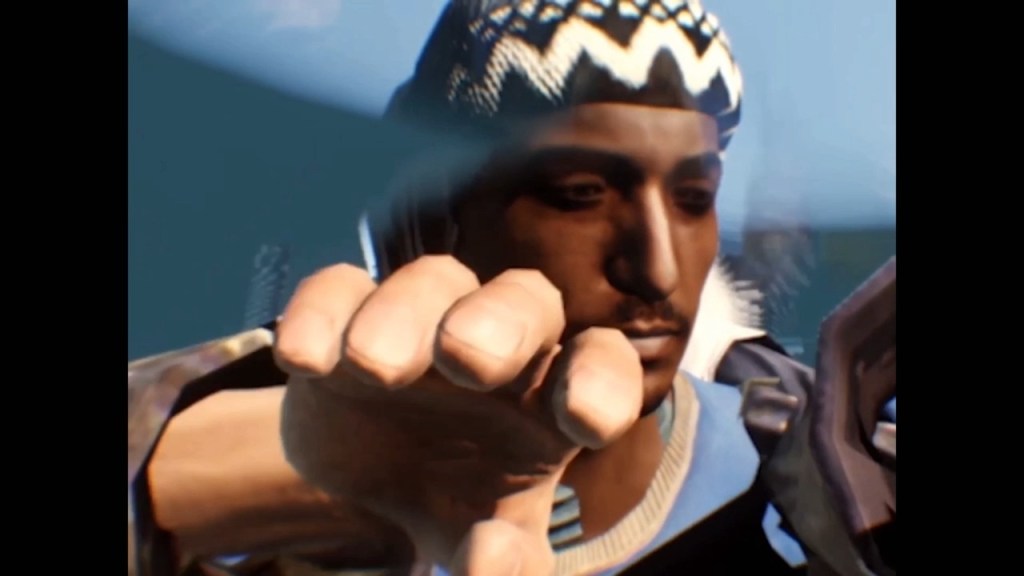
Mansour, however, is not so affable in his quotations and, instead of denouncing binary victimisation (good, bad) through the aesthetics of cinema or art, he goes straight to the political guillotine, copying and using as voice-over, in its original English, of President Trump’s speech at the Arab Islamic American Summit in Riyadh (Saudi Arabia) on 21 May 2017, while interspersing images of Arabs in traditional dress sitting comfortably watching missile flashes in a digital night scene. But as if that weren’t enough, in the chapter ‘On birds and beasts,’ it focuses on a couple of soldiers lamenting not having participated in a mission like the one in Abu Ghraib. The Abu Ghraib prison complex—despite the series of atrocities and abuses committed there and documented with photos and videos as trophies by the soldiers themselves—is portrayed as an icon of justice, endorsed not only by the main official media but also by the commercial media. And he did not leave out Horace Vernet, the court painter of Louis Philippe I, who glorified the conquest by translating it into a just feat. I was about to mention Noam Chomsky as another intellectual who has been highlighting this transgression of social and political imaginings for decades, but… there was no time. Pity.

 Pantagruel´s liquor
Leave a comment