Review by Fernando Figueroa
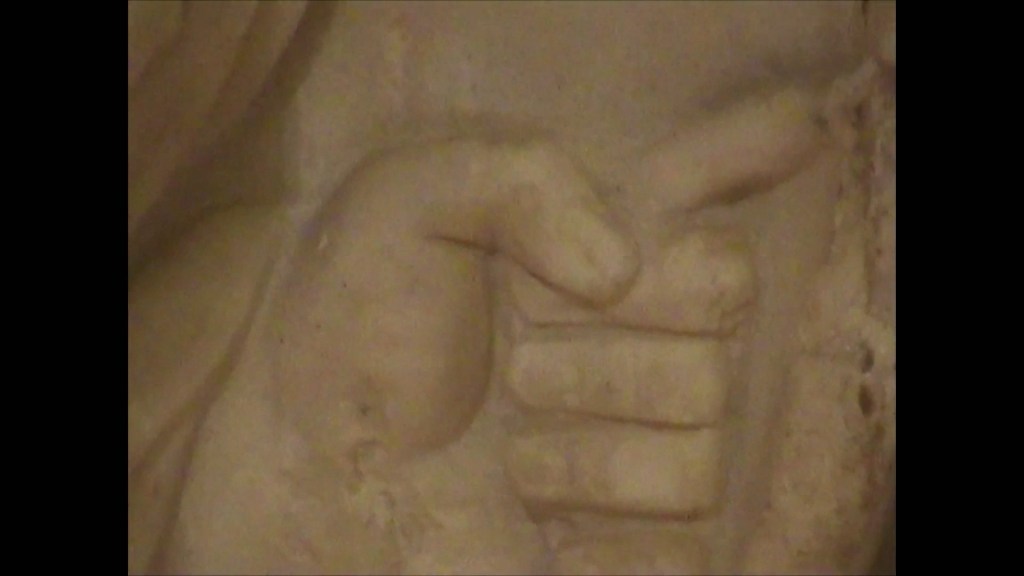
A clever peculiarity that raises disturbing philosophical questions, even if they are not obvious. With his clearly fictional interaction with the ancient pieces on display, which he touches and even licks (as the local sound invites him to do), Ouayda ironises the role of the Lebanese museum as a venue whose public display apparently preserves historical relics but also hides—upon closer reflection—a palimpsest of shame and material deterioration of the sculptures, an irrefutable consequence of the intangible and shameful damage caused by the civil war that began in 1975 and forced the museum to close. Any museum bears witness to historical events, but the bullet holes in the Beirut Museum reveal Ouayda’s sarcastic premise, as well as, of course, his debatable (though, in my opinion, ingenious) decision to call what would usually be defined as a relic or artefact an ‘artifact’. Here, instead, there is no interest in naming them, for example, Michelangelo’s Pietà or the Rosetta Stone as the Egyptian stele in the British Museum. Thus, the tour becomes a quick excursion through a critical palimpsest, as I alluded to above, despite the technical rusticity of the short film (the poor lighting and the uneven panning, with a lack of sufficient precision in focusing on the images and their details due to the film’s speed). I very much doubt that this is a political libel against a specific group. It is not against a particular regime of the civil war that ended in 1991, but against war in general, covering up and revealing, covering up and revealing again and again deliberately discriminated layers of culture and history.
Brief excerpt. Visit https://wp.me/aguJCZ-aI
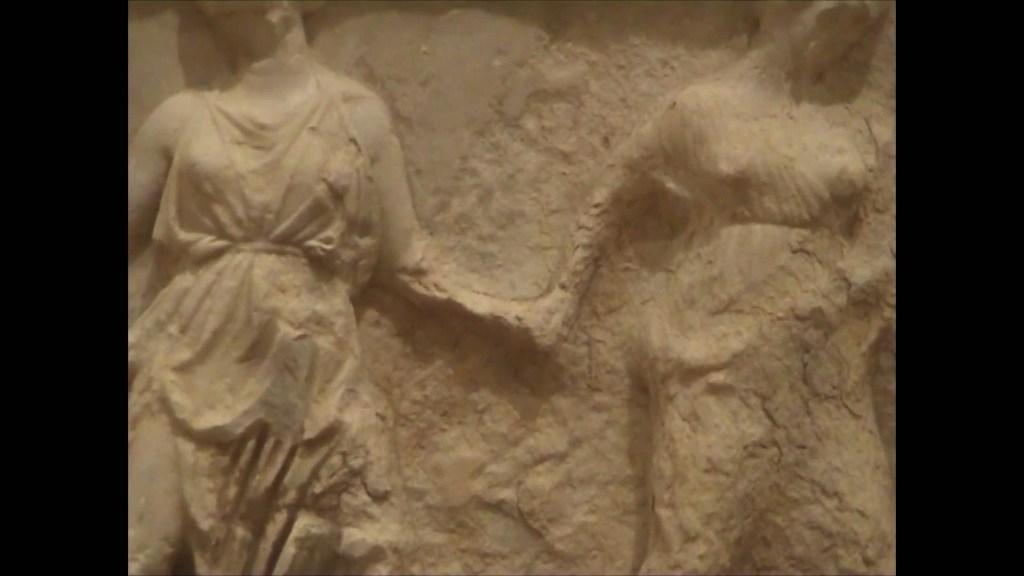
Right from the start of the short film or guided tour, the false guides or voiceovers, Danya Hammoud and Ghalas Charara point out the important marks on the stone reliefs and list the mutilations, the embedded holes, the marks left by uniforms and even the gold stains on the sculptures. From artefact 1 on the tour, with the piece that supposedly grants eternal life but fails to convince of its power, either by its size or shape, she explains that it was found underwater in the Mediterranean Sea not far from the beach in Sour. He almost reaches sarcasm when he says that the sculpture ‘has never been touched by a modern man or woman’. Is she referring to the fact that the government, during its rescue, did not have a shred of modern civilisation due to its fanaticism or political intransigence? I will pause at artefact #2, a stele with 15 female figures which the ‘museum guide’ calls ‘the 15 women’, again skilfully using the fallacy of equivocation because he mentions that the guide gives her explanation sometimes in French, sometimes in Arabic, but in any case, ‘about fifteen women follow her and their route through the museum is predetermined’. These are the artefacts, the stele with 15 female figures. Then the voiceover says: whether the guide is speaking in front of the artefacts (it no longer says that they are women) or with her back to the artefacts and facing her audience, the guide always gives the same speech. She refers to the artefacts as women again, saying that the 15 intertwined women ‘are trying to decipher a single phrase written in the Phoenician alphabet. It has been said that if you look at a sentence written in an incomprehensible language long enough, its meaning will eventually be revealed to you.’ I was inclined to interpret this as an allusion to female subjugation by Islam.
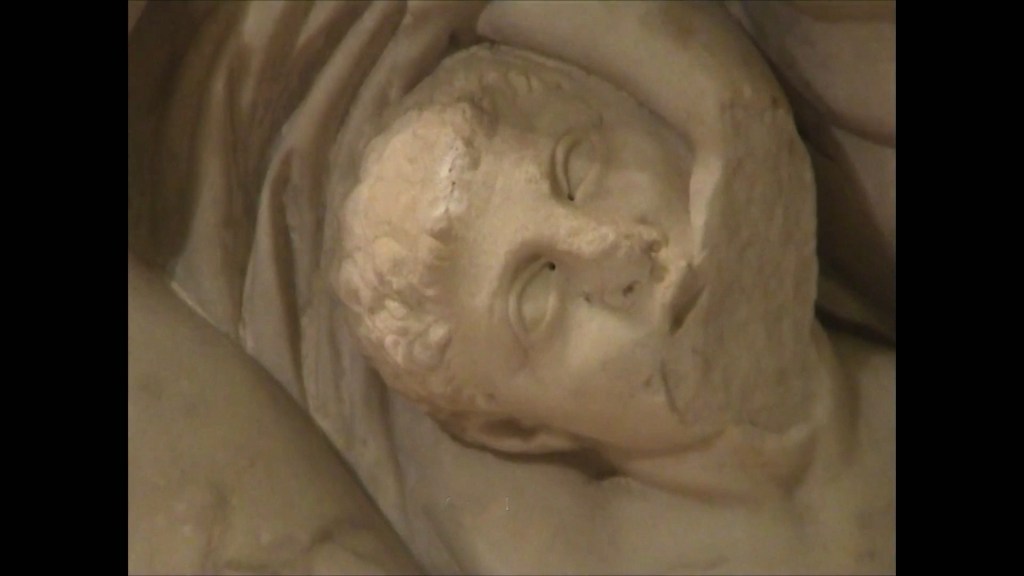
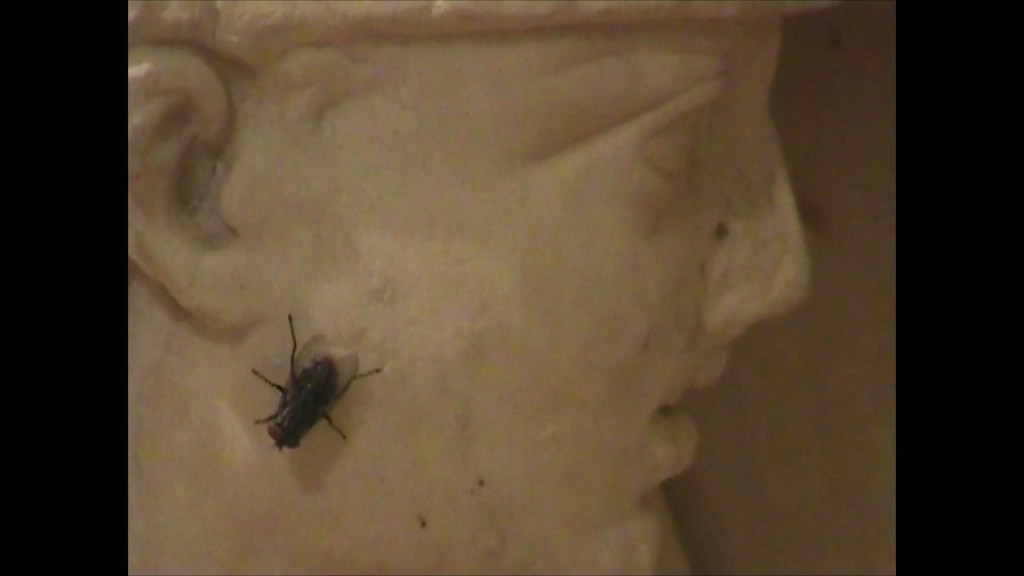
But what the voiceover said at the end confused me: ‘Enter this group of women, move among them, brushing their bodies, and when you find yourself in front of the incomprehensible phrase [they are trying to decipher], place your tongue on the limestone surface and slide it up and down, then from left to right. The women will do the same.’ This work does not need to focus on rocks or linger on rags. When it focuses and lingers, it is to mock a fly that has landed on the ‘relic.’ Its denunciation is subliminal in the guide. This is only fair, after centuries in which the ‘guides’ of culture and history have been politicians or religious figures. Ouayda was never interested in the pieces in this exhibition as art or relics, which is why he even skips artefacts 3, 4, 5 and 6. The work is not an allegory for new forms of museography. It is a subliminal denunciation that comes from the entertaining but rebellious guide. Excellent work.
 Pantagruel´s liquor
Leave a comment